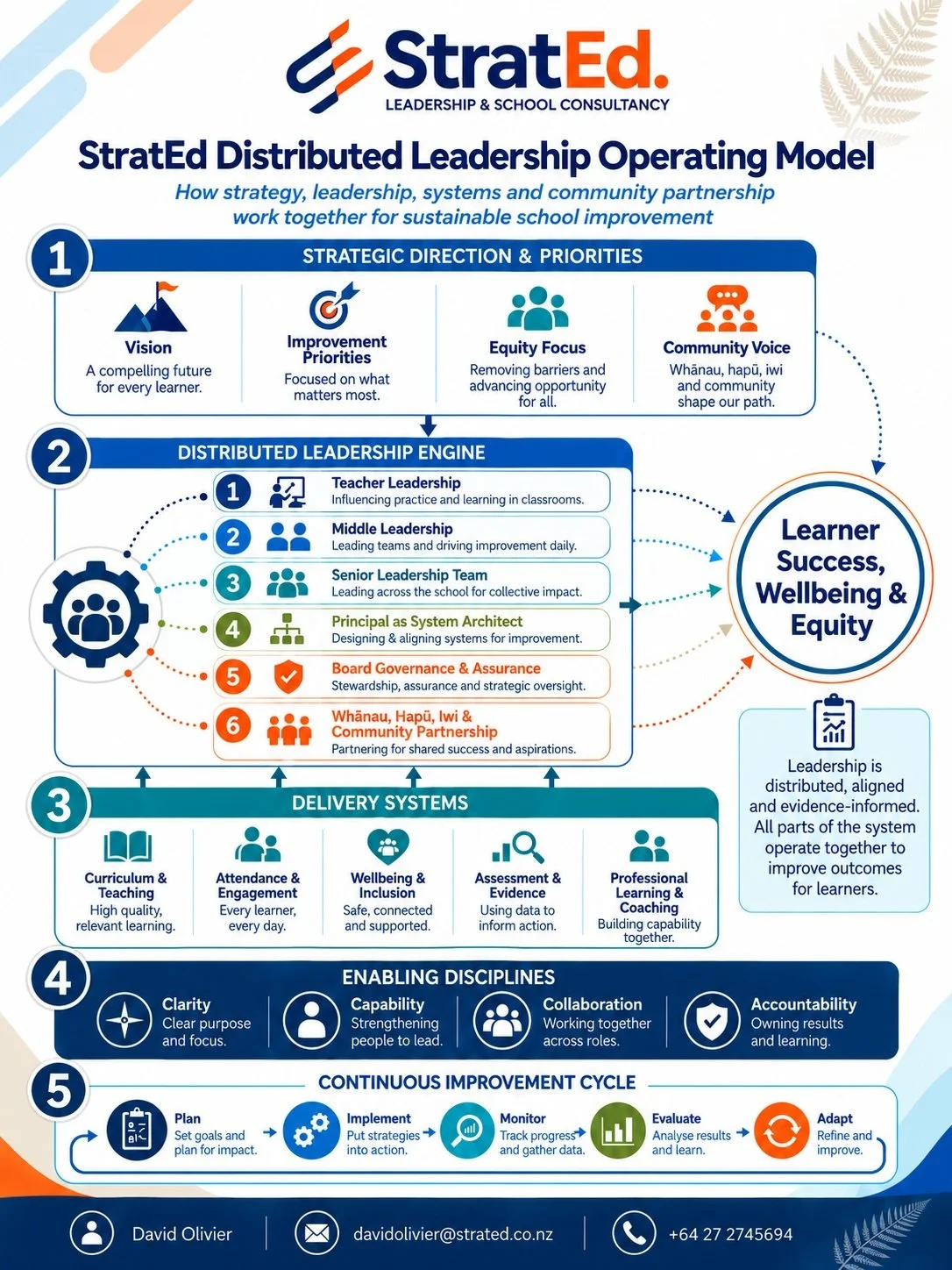
What is Distributed leadership?
Distributed leadership is the intentional distribution of leadership responsibilities across a school so that the right people lead the right work, with clear authority, support, evidence and accountability.
Core features
Shared responsibility: Leadership roles are held by a range of staff — senior leaders, middle leaders, curriculum and pastoral leaders, team and teacher leaders, support staff and, where appropriate, board-level governors — rather than concentrated in a few individuals.
Role clarity: Each leader has clearly defined responsibilities and the authority to act within their remit.
Support and development: Leaders receive targeted professional development, coaching and resources to succeed in their roles.
Evidence-informed practice: Decisions and initiatives are guided by reliable data and evidence about impact.
Accountability: Expectations and measures for success are explicit; leaders are accountable for outcomes within their areas.
Intentional design: Structures and processes are deliberately organised so that leadership sits closest to the students and the work it affects.
What distributed leadership is not
Not everyone leading everything: It is not a diffusion of responsibility or an absence of clear decision-making. It’s targeted delegation aligned to expertise and authority.
Key benefits
Reduces leadership burnout: Workload and accountability are shared, reducing pressure on a few individuals.
Builds leadership capacity: Expands the school’s pool of skilled leaders for current and future needs.
Improves decision making: Local knowledge and expertise inform more timely and relevant decisions.
Strengthens ownership: Staff leading work take greater responsibility for outcomes and continuous improvement.
Improves implementation: Those closest to classroom practice drive changes, improving fidelity and effectiveness.
Strengthens middle leadership: Middle leaders gain influence, autonomy and professional growth.
Supports sustainable improvement: Leadership is embedded across the organisation, reducing dependence on individual leaders.
Improves staff culture: More distributed responsibility fosters collaboration, morale and professional agency.
Gives boards better assurance: Well-defined leadership roles and evidence-based reporting improve governance oversight.
Keeps leadership closest to students: Decision-makers with direct student and classroom proximity can respond to needs more effectively.
Indicators of effective distributed leadership
Clear role descriptions and decision-making pathways.
Regular, evidence-based reporting from leaders at all levels.
Staff report increased agency and clarity about responsibilities.
Improved implementation fidelity for key initiatives.
Reduced concentration of workload and fewer signs of leadership burnout.
Board receives timely, relevant assurance about school performance.
Bottom line Distributed leadership deliberately positions leadership authority and responsibility with those best placed to improve student outcomes. When designed and supported well, it increases capacity, improves decisions and implementation, strengthens middle leadership and makes improvement more sustainable while protecting leaders from burnout.
If you would like to know more around developing Distributed Leadership in your school, connect with me through the “Connect with StratEd” button below.